A Common Electrical-Energy Basis for Comparing Lunar Oxygen and Propellant Production Routes
Abstract
Lunar in-situ propellant production is widely proposed as the key to affordable cislunarCislunarThe region of space between Earth and the Moon (and lunar orbit); the market lunar propellant is meant to serve. transport, yet the basic engineering question (which oxygen-extraction route costs the least energy per kilogram of product) is hard to answer from the literature, because published figures are reported on incompatible bases: hydrogen reductionHydrogen reductionReact ilmenite with H2 at ~1073-1373 K to make water, which is then electrolyzed; the one route with a clean published energy figure. as electrical energy, carbothermal reductionCarbothermal reductionReact regolith with carbon/methane at ~1900 K to free oxygen as CO/CO2, then recover it. as thermal energy, and molten regolith electrolysisMolten regolith electrolysis (MRE)Melt raw regolith to ~1900 K and electrolyze the melt to draw off oxygen. (MREMolten Regolith ElectrolysisMelt raw regolith to ~1900 K and pass current through the melt to split out oxygen, leaving metal.) with no like-for-like electrical figure (NASANational Aeronautics and Space Administration reactor-sizing models report whole-system numbers at much wider boundaries). Prior work compares subsets (Taylor and Carrier 1993 reviewed ~20 processes; Leger et al. 2025 modeled several on a common basis), but no published comparison places all five of these routes on a single electrical-equivalentElectrical-equivalent energyThermal demand converted to the electricity it would take to supply it (via an explicit heating-efficiency knob), so all routes compare on one basis. basis with paired uncertainty propagation; that common basis, not any first-ever number, is this paper's contribution. We present a small, open, uncertainty-quantified model that places five routes (hydrogen reductionHydrogen reductionReact ilmenite with H2 at ~1073-1373 K to make water, which is then electrolyzed; the one route with a clean published energy figure., carbothermal reductionCarbothermal reductionReact regolith with carbon/methane at ~1900 K to free oxygen as CO/CO2, then recover it., MREMolten Regolith ElectrolysisMelt raw regolith to ~1900 K and pass current through the melt to split out oxygen, leaving metal., molten-salt electrolysisElectrolysisUsing electric current to split a compound (here, water into H2 and O2, or oxide melts into metal and O2); an irreducibly electrical load., and polar water-ice miningPolar water-ice miningSublimate water ice out of permanently shadowed regolith at ~273 K and cold-trap the vapor; the only low-temperature route.) on one electrical-equivalentElectrical-equivalent energyThermal demand converted to the electricity it would take to supply it (via an explicit heating-efficiency knob), so all routes compare on one basis. kWhKilowatt-hourA unit of energy (one kilowatt sustained for one hour). The paper reports kWh per kg of oxygen./kg O2Molecular oxygenThe primary product; energy is reported per kg of O2 delivered to cryogenic storage. basis under a single explicit system boundarySystem boundaryWhich process stages are counted in the energy total; inconsistent boundaries are a main reason published figures disagree., with Monte-CarloMonte CarloRun the model thousands of times (here 20,000), each drawing random input values from their ranges, to build an output distribution instead of a single number. propagation of literature parameter ranges. Continuous standing losses are charged symmetrically: every high-temperature route carries a reactor heat-loss term grounded in the only measured carbothermalCarbothermal reductionHigh-temperature (~1900 K) reduction of regolith using carbon or methane to liberate oxygen. datum (NASANational Aeronautics and Space Administration CaRDCarbothermal Reduction DemonstrationNASA brassboard test; the only measured carbothermal datum, which sets the reactor heat-loss term (~63-93 kWh-thermal/kg O2).), and the low-temperature water route carries its own charge sheet (vapor-capture efficiency, cryogenic excavation, a permanently-shadowed-region standing loss, and the ice's full thermal chain), so no route is exempted from the loss categories that burden its competitors. We check the framework against the one route with a clean published electrical figure (hydrogen reductionHydrogen reductionReact ilmenite with H2 at ~1073-1373 K to make water, which is then electrolyzed; the one route with a clean published energy figure., Leger et al. 2025, 24.3 +/- 5.8 kWhKilowatt-hourA unit of energy (one kilowatt sustained for one hour). The paper reports kWh per kg of oxygen./kg LOXLiquid OxygenCryogenic liquid O2, stored at ~80-90 K; the oxidizer half of the propellant.): our loss-free configuration of that route reproduces Leger's central value (nominal 24.3, Monte-CarloMonte CarloRun the model thousands of times (here 20,000), each drawing random input values from their ranges, to build an output distribution instead of a single number. median ~21), reported as substantial interval overlap between two independent estimates. Using a paired Monte CarloPaired Monte CarloEach random trial uses one shared parameter draw across all routes, so they can be ranked head-to-head (P route A cheaper than B) rather than by separate error bars. that shares common parameters across routes, we report dominanceDominance probabilityThe probability one route beats the others, e.g. P(cheapest), read off the paired Monte Carlo. probabilities rather than overlapping error bars. The central finding is that on an all-electric basis the polar water-ice route is the most energy-efficient (cheapest in 89% of paired trials) and the only route that yields a complete LOXLiquid OxygenCryogenic liquid O2, stored at ~80-90 K; the oxidizer half of the propellant.+LH2Liquid HydrogenCryogenic liquid H2 (boils ~20 K); the fuel half of a complete LOX+LH2 propellant. propellant, though its margin narrows once it is charged for capture, excavation, and standing loss: water (~16 kWhKilowatt-hourA unit of energy (one kilowatt sustained for one hour). The paper reports kWh per kg of oxygen./kg O2Molecular oxygenThe primary product; energy is reported per kg of O2 delivered to cryogenic storage.) versus a high-temperature cluster at ~21-32, with hydrogen reductionHydrogen reductionReact ilmenite with H2 at ~1073-1373 K to make water, which is then electrolyzed; the one route with a clean published energy figure. the most likely worst once its standing loss is charged. The advantage is structural: water miningPolar water-ice miningSublimate water ice out of permanently shadowed regolith at ~273 K and cold-trap the vapor; the only low-temperature route. is the only low-temperature route (sublimationSublimationA solid passing directly to vapor without melting; water ice sublimes at ~273 K under vacuum, the basis of the low-temperature water route. at ~273 K), so it escapes the large, continuous reactor heat-loss penalty (~63-93 kWh-thermalKilowatt-hour, thermalA unit of heat energy, as opposed to electrical energy. Converting between the two via an efficiency knob is the core of this paper./kg O2Molecular oxygenThe primary product; energy is reported per kg of O2 delivered to cryogenic storage. in the one measured carbothermalCarbothermal reductionHigh-temperature (~1900 K) reduction of regolith using carbon or methane to liberate oxygen. demonstration) that burdens every high-temperature thermochemical or electrochemical route. The result is, however, conditional on heat being electrically supplied: a solar-thermal sensitivity shows that concentrated sunlight at a sunlit site inverts the ranking (carbothermalCarbothermal reductionHigh-temperature (~1900 K) reduction of regolith using carbon or methane to liberate oxygen. falls to ~8 kWh-electric/kg O2Molecular oxygenThe primary product; energy is reported per kg of O2 delivered to cryogenic storage.), at the cost of concentrator mass and of being at the wrong site for water. A sensitivity analysis identifies the single highest-value measurement for each route, we translate energy into required surface power and landed fission-plant mass, and we outline two companion analyses on reusing co-located compute waste heat (which is, fittingly, most useful precisely at the low-temperature water route).
1. Introduction
The case for lunar propellant rests on energy: every process that turns regolithRegolithThe loose, broken-rock surface layer of the Moon; the feedstock for every non-water route. or polar ice into liquid oxygen (and ideally liquid hydrogen) is energy-intensive, and surface power is the binding constraint on any near-term architecture. Yet the comparison that should drive route selection has never been made on equal footing. Three incompatibilities recur in the literature:
- Thermal vs electrical energy are conflated. Carbothermal reductionCarbothermal reductionReact regolith with carbon/methane at ~1900 K to free oxygen as CO/CO2, then recover it. is reported as delivered thermal energy or "g O2Molecular oxygenThe primary product; energy is reported per kg of O2 delivered to cryogenic storage./kWhKilowatt-hourA unit of energy (one kilowatt sustained for one hour). The paper reports kWh per kg of oxygen. thermal"; hydrogen reductionHydrogen reductionReact ilmenite with H2 at ~1073-1373 K to make water, which is then electrolyzed; the one route with a clean published energy figure. is reported as electrical kWhKilowatt-hourA unit of energy (one kilowatt sustained for one hour). The paper reports kWh per kg of oxygen./kg. On the Moon both ultimately draw on the same scarce electrical supply, but they are not interchangeable at face value.
- System boundaries differ. Some figures include excavation, beneficiationBeneficiationConcentrating or sorting raw regolith to enrich the useful feedstock before processing., and liquefactionLiquefactionCooling a gas into a cryogenic liquid (e.g. O2 to LOX); a leading cost of the water route is LH2 liquefaction.; others count only the reactor.
- Two routes have no like-for-like figure. Molten regolith electrolysisMolten regolith electrolysis (MRE)Melt raw regolith to ~1900 K and electrolyze the melt to draw off oxygen. and molten-salt electrolysisMolten-salt electrolysisElectrolysis of oxide feed dissolved or suspended in a molten salt bath (the FFC Cambridge route here). are described qualitatively or at incompatible whole-system boundaries; no published number for either sits on the same basis as the reduction routes.
The consequence is that capital allocation, power-plant sizing, and architecture choice rest on a comparison that does not exist. This is a modeling gap, not a hardware gap, which is precisely why it can be closed now, cheaply, and reproducibly. We build that comparison and quantify its uncertainty.
2. Methods
2.1 Functional unit and system boundary
We compute the electrical-equivalentElectrical-equivalent energyThermal demand converted to the electricity it would take to supply it (via an explicit heating-efficiency knob), so all routes compare on one basis. energy in kWhKilowatt-hourA unit of energy (one kilowatt sustained for one hour). The paper reports kWh per kg of oxygen. per kg of O2Molecular oxygenThe primary product; energy is reported per kg of O2 delivered to cryogenic storage. delivered to cryogenic storage, and additionally report kWhKilowatt-hourA unit of energy (one kilowatt sustained for one hour). The paper reports kWh per kg of oxygen. per kg of total propellant for the one route that co-produces hydrogen. The system boundarySystem boundaryWhich process stages are counted in the energy total; inconsistent boundaries are a main reason published figures disagree. is a fixed sequence of stages; every route enables a subset, using the same stage sub-models, so all differences between routes arise from parameters rather than inconsistent accounting:
excavation/acquisition -> beneficiationBeneficiationConcentrating or sorting raw regolith to enrich the useful feedstock before processing. -> heating (sensible, plus fusion for melt routes) -> reaction (reduction enthalpyEnthalpyThe heat absorbed or released by a reaction or phase change at constant pressure. or FaradaicFaradaicPertaining to charge-transfer in electrochemistry; the work an electrolysis reaction demands per the Faraday relation. electrolysisElectrolysisUsing electric current to split a compound (here, water into H2 and O2, or oxide melts into metal and O2); an irreducibly electrical load.) -> product cleanup -> water electrolysisElectrolysisUsing electric current to split a compound (here, water into H2 and O2, or oxide melts into metal and O2); an irreducibly electrical load. (where the route produces H2OWater) -> gas compression -> liquefactionLiquefactionCooling a gas into a cryogenic liquid (e.g. O2 to LOX); a leading cost of the water route is LH2 liquefaction. (LOXLiquid OxygenCryogenic liquid O2, stored at ~80-90 K; the oxidizer half of the propellant. always; LH2Liquid HydrogenCryogenic liquid H2 (boils ~20 K); the fuel half of a complete LOX+LH2 propellant. where hydrogen is retained).
2.2 Thermal-to-electrical conversion
To compare a thermally-reported route against electrically-reported ones, all thermal demand is converted to electrical-equivalentElectrical-equivalent energyThermal demand converted to the electricity it would take to supply it (via an explicit heating-efficiency knob), so all routes compare on one basis. through an explicit electric-to-thermal efficiency parameter (resistive heating, nominal 0.90). This single, visible knob is what makes the comparison honest. The choice of an all-electric baseline is itself a siting assumption: it is exact for a permanently shadowed regionPermanently Shadowed RegionA crater floor near the poles that never sees sunlight, sitting at ~40-110 K: both the water resource and an ideal cold sink. and for nuclear-powered architectures, but at a sunlit site concentrated sunlight can supply high-gradeHigh-grade heatHeat at high temperature (1073-1900 K) needed to drive reduction and electrolysis routes. process heat directly. Because that choice turns out to matter to the ranking, we report a solar-thermal pathway as an explicit sensitivity (Section 5), not bury it.
2.3 Uncertainty propagation
Every uncertain input is a triangularTriangular distributionA simple probability shape defined by a low, nominal (most-likely), and high value; used here for every uncertain input. (low, nominal, high) distribution sourced from the
literature (the full parameter table, with a citation on every value, is in params.py).
A 20,000-trial Monte CarloMonte CarloRun the model thousands of times (here 20,000), each drawing random input values from their ranges, to build an output distribution instead of a single number. propagates these to a 90% interval per route. We propagate
stated literature ranges, not assumed Gaussian measurement error. The electrolysisElectrolysisUsing electric current to split a compound (here, water into H2 and O2, or oxide melts into metal and O2); an irreducibly electrical load. cell
voltage and current efficiencyCurrent efficiencyFraction of electrical current that does useful electrolysis rather than side reactions. of the electrochemical routes are sampled with a physical
anti-correlationAnti-correlationTwo parameters forced to move in opposite directions in sampling (voltage up as efficiency down) to avoid physically impossible combinations. (a shared operating-severity latent: higher current densityCurrent densityCurrent per unit electrode area; raising it lifts voltage and lowers efficiency together (the anti-correlation modeled here). raises voltage
and lowers efficiency together), avoiding unphysical parameter corners. The water route's
new charge-sheet parameters (capture efficiency, cryogenic excavation specific energy, PSRPermanently Shadowed RegionA crater floor near the poles that never sees sunlight, sitting at ~40-110 K: both the water resource and an ideal cold sink.
standing loss; Section 2.6) are sampled the same way.
2.4 Ranking by paired Monte Carlo
Reading a ranking from five marginal error bars is a statistical error, because the routes share parameters (regolithRegolithThe loose, broken-rock surface layer of the Moon; the feedstock for every non-water route. specific heatSpecific heat (cp)Energy to raise one kilogram of material by one degree; sets the sensible-heating demand., heat recuperationHeat recuperationRecovering heat from hot product/exhaust to preheat incoming feed, cutting net heating energy., electrolysisElectrolysisUsing electric current to split a compound (here, water into H2 and O2, or oxide melts into metal and O2); an irreducibly electrical load. efficiency, liquefactionLiquefactionCooling a gas into a cryogenic liquid (e.g. O2 to LOX); a leading cost of the water route is LH2 liquefaction.) that must take the same value in any given world. We therefore run a paired Monte CarloMonte CarloRun the model thousands of times (here 20,000), each drawing random input values from their ranges, to build an output distribution instead of a single number.: one shared parameter draw per trial across all routes, evaluated trial by trial, so we can report P(route A cheaper than route B) and P(route is cheapest / worst).
2.5 Continuous standing losses, charged symmetrically
A reactor held continuously at 800-1900 C radiates and conducts heat to its surroundings independently of the per-kg sensible heatingSensible heatHeat that changes a material’s temperature (as opposed to latent heat of a phase change)., a term the sensible-heat-only stages omit. The only measured carbothermalCarbothermal reductionHigh-temperature (~1900 K) reduction of regolith using carbon or methane to liberate oxygen. datum (NASANational Aeronautics and Space Administration's CaRDCarbothermal Reduction DemonstrationNASA brassboard test; the only measured carbothermal datum, which sets the reactor heat-loss term (~63-93 kWh-thermal/kg O2). brassboardBrassboardAn early functional engineering prototype, not yet flight-like; the CaRD brassboard is the only measured carbothermal datum.) implies ~63-93 kWh-thermalKilowatt-hour, thermalA unit of heat energy, as opposed to electrical energy. Converting between the two via an efficiency knob is the core of this paper. per kg O2Molecular oxygenThe primary product; energy is reported per kg of O2 delivered to cryogenic storage. for the reduction step, dominated by this loss at demonstrated (tiny) scale. A scaled, well-insulated plant amortizes it over far more throughput, so the true value is highly scale-dependent. We therefore add a single reactor-loss term (log-triangular, nominal 8, range 2-30 kWhKilowatt-hourA unit of energy (one kilowatt sustained for one hour). The paper reports kWh per kg of oxygen./kg O2Molecular oxygenThe primary product; energy is reported per kg of O2 delivered to cryogenic storage.: 2 for a large well-insulated plant, ~30 approaching the brassboardBrassboardAn early functional engineering prototype, not yet flight-like; the CaRD brassboard is the only measured carbothermal datum. upper bound) to all four high-temperature routes, hydrogen reductionHydrogen reductionReact ilmenite with H2 at ~1073-1373 K to make water, which is then electrolyzed; the one route with a clean published energy figure. included. An earlier version of this model exempted hydrogen reductionHydrogen reductionReact ilmenite with H2 at ~1073-1373 K to make water, which is then electrolyzed; the one route with a clean published energy figure. on the argument that its Leger 2025 anchor already reflected realistic reduction energy; that exemption was inconsistent with the model's own claim that the route is built bottom-up from independent parameters, and it undercharged the route by ~8 kWhKilowatt-hourA unit of energy (one kilowatt sustained for one hour). The paper reports kWh per kg of oxygen./kg at nominal. The headline now charges the loss symmetrically; the loss-free configuration is retained as an explicit model option and is what the Leger validation tests against (Section 3.1). This term, omitted entirely in an early version of the model, is what once made carbothermalCarbothermal reductionHigh-temperature (~1900 K) reduction of regolith using carbon or methane to liberate oxygen. appear cheapest.
The water route is not exempt from standing loss either. Its sublimationSublimationA solid passing directly to vapor without melting; water ice sublimes at ~273 K under vacuum, the basis of the low-temperature water route. zone runs at ~273 K inside a 40-110 K environment, so it radiates and conducts heat into cold regolithRegolithThe loose, broken-rock surface layer of the Moon; the feedstock for every non-water route. that yields no water. We charge it a PSRPermanently Shadowed RegionA crater floor near the poles that never sees sunlight, sitting at ~40-110 K: both the water resource and an ideal cold sink. standing-loss term (log-triangular, nominal 1.5, range 0.3-8 kWhKilowatt-hourA unit of energy (one kilowatt sustained for one hour). The paper reports kWh per kg of oxygen./kg O2Molecular oxygenThe primary product; energy is reported per kg of O2 delivered to cryogenic storage.), smaller than the reactor term because radiative loss scales as T^4 and 273 K is far below 1100-1900 C, but not zero.
2.6 The water route's charge sheet
An earlier version of this model charged the water route for thermal miningPolar water-ice miningSublimate water ice out of permanently shadowed regolith at ~273 K and cold-trap the vapor; the only low-temperature route., electrolysisElectrolysisUsing electric current to split a compound (here, water into H2 and O2, or oxide melts into metal and O2); an irreducibly electrical load., and liquefactionLiquefactionCooling a gas into a cryogenic liquid (e.g. O2 to LOX); a leading cost of the water route is LH2 liquefaction. and nothing else, which exempted it from every loss category that burdened its competitors. Version 0.13 charges it symmetrically:
- Vapor-capture efficiency (nominal 0.75, range 0.50-0.95): tent or cold-trapCold trapA surface cold enough to freeze out vapor; PSRs act as natural cold traps, and the plant uses one to capture sublimated water vapor. capture over fissured terrain in vacuum does not collect every sublimated molecule; mining heat and regolithRegolithThe loose, broken-rock surface layer of the Moon; the feedstock for every non-water route. throughput scale by its inverse.
- Cryogenic excavation (nominal 30 kJ/kg regolithRegolithThe loose, broken-rock surface layer of the Moon; the feedstock for every non-water route., log range 2-200): icy regolithRegolithThe loose, broken-rock surface layer of the Moon; the feedstock for every non-water route. at 40-110 K has concrete-like strength; rock-cutting specific energies are orders of magnitude above the dry-simulant bucket-drum figure used for the regolithRegolithThe loose, broken-rock surface layer of the Moon; the feedstock for every non-water route. routes. The wide log range spans radiant in-situ concepts (low end) to mechanical cutting of competent icy ground (high end).
- PSRPermanently Shadowed RegionA crater floor near the poles that never sees sunlight, sitting at ~40-110 K: both the water resource and an ideal cold sink. standing loss (Section 2.5).
- The ice's own thermal chain: sensible heatSensible heatHeat that changes a material’s temperature (as opposed to latent heat of a phase change). of the ice from feed temperature to 273 K (cp_ice ~1.75 kJ/kgK) and a reconditioning term (nominal 0.12 kWhKilowatt-hourA unit of energy (one kilowatt sustained for one hour). The paper reports kWh per kg of oxygen./kg O2Molecular oxygenThe primary product; energy is reported per kg of O2 delivered to cryogenic storage.) for refreezing captured vapor at the cold trapCold trapA surface cold enough to freeze out vapor; PSRs act as natural cold traps, and the plant uses one to capture sublimated water vapor. and re-melting it for the electrolyzer feed.
- One correction in the route's favor: the regolithRegolithThe loose, broken-rock surface layer of the Moon; the feedstock for every non-water route. sensible term now uses a cryo-range specific heatSpecific heat (cp)Energy to raise one kilogram of material by one degree; sets the sensible-heating demand. (nominal 0.45 kJ/kgK over 70-273 K) instead of the 1.15 enthalpy-mean over 250-1300 K, which had overstated the water route's sensible heatSensible heatHeat that changes a material’s temperature (as opposed to latent heat of a phase change). roughly twofold. The hot routes keep the hot-range value.
The net effect of the charge sheet is to raise the water route's nominal from 14.0 to 15.8 kWhKilowatt-hourA unit of energy (one kilowatt sustained for one hour). The paper reports kWh per kg of oxygen./kg O2Molecular oxygenThe primary product; energy is reported per kg of O2 delivered to cryogenic storage. and to widen its interval; the route survives it (Section 4), which is a far stronger statement than the earlier result that exempted it.
3. Validation
3.1 Hydrogen reduction against Leger 2025 (and a second anchor)
Hydrogen reductionHydrogen reductionReact ilmenite with H2 at ~1073-1373 K to make water, which is then electrolyzed; the one route with a clean published energy figure. is the only route with a clean published electrical figure: 24.3 +/- 5.8 kWhKilowatt-hourA unit of energy (one kilowatt sustained for one hour). The paper reports kWh per kg of oxygen./kg LOXLiquid OxygenCryogenic liquid O2, stored at ~80-90 K; the oxidizer half of the propellant., with the reduction step ~55% and water electrolysisElectrolysisUsing electric current to split a compound (here, water into H2 and O2, or oxide melts into metal and O2); an irreducibly electrical load. ~38% of the total [leger2025]. We built our estimate bottom-up from first principles and independent parameters; the largest tunable term (water-electrolysis efficiency) is set from an independent SOECSolid Oxide Electrolysis CellHigh-temperature electrolyzer; its independently-sourced efficiency sets the water-electrolysis term. source [hauch2020; iea2019], not from Leger's implied value.
The comparison is made in the model's loss-free configuration (continuous standing loss zeroed), because Leger's full-chain figure contains no continuous standing-loss term that we can identify; the agreement below is evidence that his boundary, like our loss-free one, omits it.
- Loss-free nominal point estimate: 24.3 kWhKilowatt-hourA unit of energy (one kilowatt sustained for one hour). The paper reports kWh per kg of oxygen./kg LOXLiquid OxygenCryogenic liquid O2, stored at ~80-90 K; the oxidizer half of the propellant., matching Leger's central value and inside his 1-sigma interval [18.5, 30.1].
- The loss-free Monte-CarloMonte CarloRun the model thousands of times (here 20,000), each drawing random input values from their ranges, to build an output distribution instead of a single number. distribution is centered lower (median ~20.7, mean ~21.1): Leger's value sits near our 85th percentile, not our center. We therefore report agreement as substantial interval overlap between two independent estimates, not as a point match; the nominal coincidence should not be over-read.
- Stage shares match: heating + reaction ~65% (Leger ~55%); water electrolysisElectrolysisUsing electric current to split a compound (here, water into H2 and O2, or oxide melts into metal and O2); an irreducibly electrical load. ~30% (Leger ~38%).
- A second cross-check: Taylor and Carrier (1993) place the route at ~26 kWhKilowatt-hourA unit of energy (one kilowatt sustained for one hour). The paper reports kWh per kg of oxygen./kg LOXLiquid OxygenCryogenic liquid O2, stored at ~80-90 K; the oxidizer half of the propellant. (cross-technology range 18-35) [taylor1993].
- The headline table charges the route the shared standing-loss term like its high-temperature siblings (nominal total 32.3 kWhKilowatt-hourA unit of energy (one kilowatt sustained for one hour). The paper reports kWh per kg of oxygen./kg O2Molecular oxygenThe primary product; energy is reported per kg of O2 delivered to cryogenic storage.). If continuous standing loss proves negligible at scale, the headline reverts toward the validated loss-free figure; the paired ranking already integrates over that range.
3.2 MRE against Carr 1963 and terrestrial molten-oxide electrolysis
MREMolten Regolith ElectrolysisMelt raw regolith to ~1900 K and pass current through the melt to split out oxygen, leaving metal. began as a pure first-principles estimate (nominal 26.5, 90% CIConfidence IntervalHere, the 90% Monte-Carlo interval: 90% of simulated trials fall inside it. [20.1, 42.0], now including the reactor-loss term). Because it has no published electrical figure on this boundary, we cross-check it against three sources that unavoidably use different system boundaries, so the agreement is weak and bounding rather than a clean anchor: Carr (1963), as reported secondarily by Schreiner (2016), gives ~26.4 kWhKilowatt-hourA unit of energy (one kilowatt sustained for one hour). The paper reports kWh per kg of oxygen./kg O2Molecular oxygenThe primary product; energy is reported per kg of O2 delivered to cryogenic storage. for lunar MREMolten Regolith ElectrolysisMelt raw regolith to ~1900 K and pass current through the melt to split out oxygen, leaving metal. [carr1963]; terrestrial molten-oxide electrolysisElectrolysisUsing electric current to split a compound (here, water into H2 and O2, or oxide melts into metal and O2); an irreducibly electrical load. of iron runs ~3.7-4.0 MWhMegawatt-hourOne thousand kilowatt-hours of energy./t metal, i.e. ~9 kWhKilowatt-hourA unit of energy (one kilowatt sustained for one hour). The paper reports kWh per kg of oxygen./kg O2Molecular oxygenThe primary product; energy is reported per kg of O2 delivered to cryogenic storage., a well-insulated lower bound for a different chemistry [allanore2015]; and NASANational Aeronautics and Space Administration reactor-sizing models place whole-system figures (including Joule heatingJoule heatingHeat produced by current flowing through electrical resistance; inflates the apparent voltage of electrolysis cells. and duty cycleDuty cycleFraction of time a system actually runs at load; lowers effective throughput and raises per-kg energy., which our standalone-reactor boundary excludes) at ~50-120 kWhKilowatt-hourA unit of energy (one kilowatt sustained for one hour). The paper reports kWh per kg of oxygen./kg O2Molecular oxygenThe primary product; energy is reported per kg of O2 delivered to cryogenic storage. [schreiner2016sizing]. Our estimate falls between these, which given their ~9-120 spread is corroboration only in a loose sense. We did, however, correct the oxide-melt current efficiencyCurrent efficiencyFraction of electrical current that does useful electrolysis rather than side reactions. to match measured regolith-surrogate data (70-90%, Ir anodesIridium (Ir) anodesThe anode material in the measured molten-oxide electrolysis data used to correct MRE current efficiency. [allanore2015]) rather than an optimistic assumption, a change that lowered MREMolten Regolith ElectrolysisMelt raw regolith to ~1900 K and pass current through the melt to split out oxygen, leaving metal.'s estimate against the prior narrative.
These are the project's falsifiable tests (tests/test_validation.py). Only hydrogen
reduction has a like-for-like published electrical figure; the others are first-principles
estimates reported with wide intervals and as probabilities, not point claims.
4. Results
Table 1. Electrical-equivalentElectrical-equivalent energyThermal demand converted to the electricity it would take to supply it (via an explicit heating-efficiency knob), so all routes compare on one basis. energy per route (20,000 trials).
| Route | Yields | kWhKilowatt-hourA unit of energy (one kilowatt sustained for one hour). The paper reports kWh per kg of oxygen./kg O2Molecular oxygenThe primary product; energy is reported per kg of O2 delivered to cryogenic storage. (nominal) | 90% CIConfidence IntervalHere, the 90% Monte-Carlo interval: 90% of simulated trials fall inside it. | kWhKilowatt-hourA unit of energy (one kilowatt sustained for one hour). The paper reports kWh per kg of oxygen./kg propellant |
|---|---|---|---|---|
| PSRPermanently Shadowed RegionA crater floor near the poles that never sees sunlight, sitting at ~40-110 K: both the water resource and an ideal cold sink. water miningPolar water-ice miningSublimate water ice out of permanently shadowed regolith at ~273 K and cold-trap the vapor; the only low-temperature route. | LOXLiquid OxygenCryogenic liquid O2, stored at ~80-90 K; the oxidizer half of the propellant.+LH2Liquid HydrogenCryogenic liquid H2 (boils ~20 K); the fuel half of a complete LOX+LH2 propellant. | 15.8 | 13.7-20.2 | 14.1 |
| CarbothermalCarbothermal reductionHigh-temperature (~1900 K) reduction of regolith using carbon or methane to liberate oxygen. (CH4MethaneThe reductant/working gas in the carbothermal route.) | LOXLiquid OxygenCryogenic liquid O2, stored at ~80-90 K; the oxidizer half of the propellant. | 21.1 | 16.1-33.1 | 21.1 |
| Molten-salt (FFCFFC Cambridge processFray-Farthing-Chen molten-salt electrolysis: oxygen is removed from solid oxide feed held in a molten salt at ~1200 K.) | LOXLiquid OxygenCryogenic liquid O2, stored at ~80-90 K; the oxidizer half of the propellant. | 23.3 | 17.9-36.2 | 23.3 |
| Molten regolith electrolysisMolten regolith electrolysis (MRE)Melt raw regolith to ~1900 K and electrolyze the melt to draw off oxygen. | LOXLiquid OxygenCryogenic liquid O2, stored at ~80-90 K; the oxidizer half of the propellant. | 26.5 | 20.1-42.0 | 26.5 |
| H2Hydrogen gas reduction (ilmeniteIlmeniteAn iron-titanium oxide mineral (FeTiO3) in lunar soil; the feedstock for hydrogen reduction.) | LOXLiquid OxygenCryogenic liquid O2, stored at ~80-90 K; the oxidizer half of the propellant. | 32.3 | 22.0-41.9 | 32.3 |
The single value is the deterministic nominal (all parameters at their cited value); for the right-skewedRight-skewedA distribution with a long high-side tail, so its mean sits above its median; true of the reactor-loss-bearing routes. routes the Monte-CarloMonte CarloRun the model thousands of times (here 20,000), each drawing random input values from their ranges, to build an output distribution instead of a single number. median can differ by a few kWhKilowatt-hourA unit of energy (one kilowatt sustained for one hour). The paper reports kWh per kg of oxygen./kg, so for plant sizing prefer the median and the interval. All five routes now carry a continuous standing-loss term (Sections 2.5-2.6): the four high-temperature routes the shared reactor loss, the water route its smaller PSRPermanently Shadowed RegionA crater floor near the poles that never sees sunlight, sitting at ~40-110 K: both the water resource and an ideal cold sink. analog. The high-temperature intervals are wide and strongly overlapping; they are not cleanly separable from one another. The water route sits below them, by a narrower margin than when it was exempt from capture, excavation, and standing-loss charges.
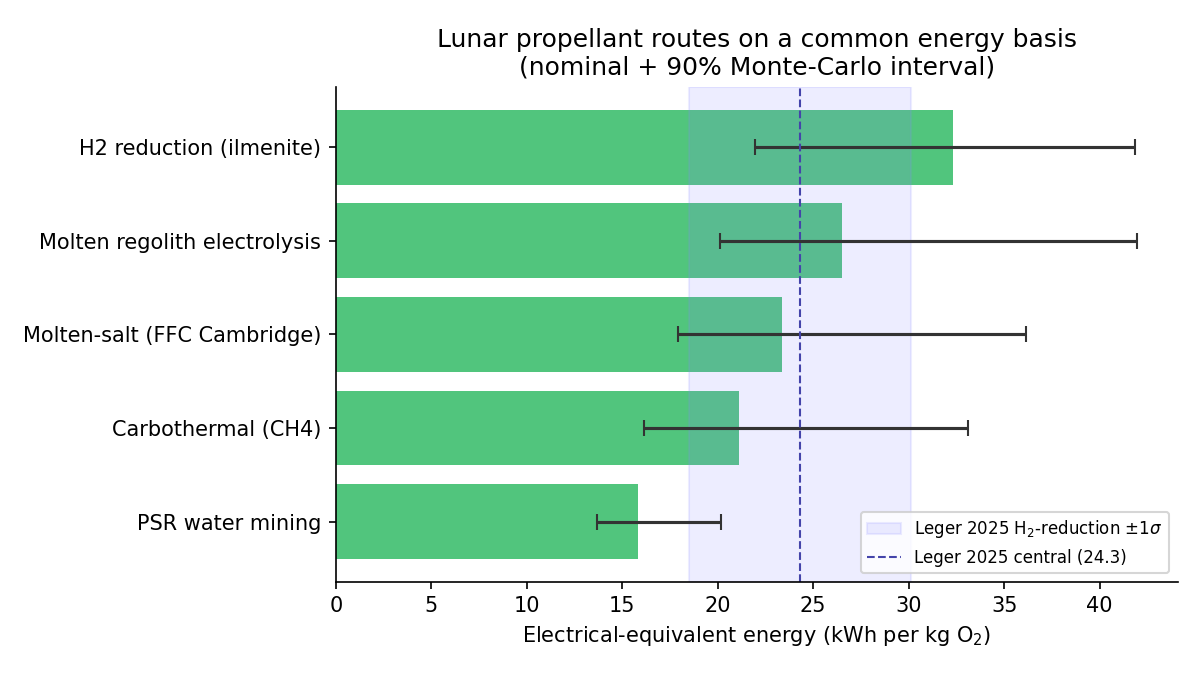
Figure 1. The five routes on a common electrical-energy basis (nominal + 90% Monte-CarloMonte CarloRun the model thousands of times (here 20,000), each drawing random input values from their ranges, to build an output distribution instead of a single number. interval); the shaded band is Leger 2025's 1-sigma for hydrogen reductionHydrogen reductionReact ilmenite with H2 at ~1073-1373 K to make water, which is then electrolyzed; the one route with a clean published energy figure. (which our loss-free configuration matches; the plotted headline charges standing loss).
Table 2. Paired-Monte-CarloPaired Monte CarloEach random trial uses one shared parameter draw across all routes, so they can be ranked head-to-head (P route A cheaper than B) rather than by separate error bars. dominanceDominance probabilityThe probability one route beats the others, e.g. P(cheapest), read off the paired Monte Carlo..
| Route | P(cheapest) | P(worst) |
|---|---|---|
| PSRPermanently Shadowed RegionA crater floor near the poles that never sees sunlight, sitting at ~40-110 K: both the water resource and an ideal cold sink. water miningPolar water-ice miningSublimate water ice out of permanently shadowed regolith at ~273 K and cold-trap the vapor; the only low-temperature route. | 0.89 | 0.00 |
| CarbothermalCarbothermal reductionHigh-temperature (~1900 K) reduction of regolith using carbon or methane to liberate oxygen. (CH4MethaneThe reductant/working gas in the carbothermal route.) | 0.10 | 0.00 |
| Molten-salt (FFCFFC Cambridge processFray-Farthing-Chen molten-salt electrolysis: oxygen is removed from solid oxide feed held in a molten salt at ~1200 K.) | 0.01 | 0.03 |
| Molten regolith electrolysisMolten regolith electrolysis (MRE)Melt raw regolith to ~1900 K and electrolyze the melt to draw off oxygen. | 0.00 | 0.43 |
| H2Hydrogen gas reduction (ilmeniteIlmeniteAn iron-titanium oxide mineral (FeTiO3) in lunar soil; the feedstock for hydrogen reduction.) | 0.00 | 0.54 |
The water route is the cheapest in 89% of paired trials and is essentially never the worst; carbothermalCarbothermal reductionHigh-temperature (~1900 K) reduction of regolith using carbon or methane to liberate oxygen. takes most of the remaining 10%. Charging hydrogen reductionHydrogen reductionReact ilmenite with H2 at ~1073-1373 K to make water, which is then electrolyzed; the one route with a clean published energy figure. the shared standing loss moves it from mid-pack to the most likely worst (0.54, with MREMolten Regolith ElectrolysisMelt raw regolith to ~1900 K and pass current through the melt to split out oxygen, leaving metal. at 0.43): its low per-batch oxygen yield (1.4-4.4 wt%Weight percent (wt%)A mass fraction expressed as a percentage; polar ice grade is assumed about 5 wt% in the water-yield estimate.) means it processes far more hot regolithRegolithThe loose, broken-rock surface layer of the Moon; the feedstock for every non-water route. per kg O2Molecular oxygenThe primary product; energy is reported per kg of O2 delivered to cryogenic storage. than any other route, so the standing-loss and recuperationHeat recuperationRecovering heat from hot product/exhaust to preheat incoming feed, cutting net heating energy. penalties hit it hardest. The high-temperature routes remain mutually inseparable within their shared uncertainty.
5. Sensitivity analysis
A one-at-a-time tornadoTornado analysisA one-at-a-time sensitivity sweep: vary each input low-to-high with others fixed, rank by the swing it causes. analysis (each parameter swept low-to-high, all others nominal;
python -m lpem --sensitivity <route>) identifies the dominant uncertainty for each route
and, with it, the single highest-value measurement:
| Route | Dominant driver (swing, kWhKilowatt-hourA unit of energy (one kilowatt sustained for one hour). The paper reports kWh per kg of oxygen./kg O2Molecular oxygenThe primary product; energy is reported per kg of O2 delivered to cryogenic storage.) | Next |
|---|---|---|
| PSRPermanently Shadowed RegionA crater floor near the poles that never sees sunlight, sitting at ~40-110 K: both the water resource and an ideal cold sink. water | PSRPermanently Shadowed RegionA crater floor near the poles that never sees sunlight, sitting at ~40-110 K: both the water resource and an ideal cold sink. standing loss (7.7) | LH2Liquid HydrogenCryogenic liquid H2 (boils ~20 K); the fuel half of a complete LOX+LH2 propellant. liquefactionLiquefactionCooling a gas into a cryogenic liquid (e.g. O2 to LOX); a leading cost of the water route is LH2 liquefaction. (6.0), ice grade (4.2), capture eff (1.6), icy excavation (1.4) |
| CarbothermalCarbothermal reductionHigh-temperature (~1900 K) reduction of regolith using carbon or methane to liberate oxygen. | reactor heat loss (28.0) | reaction enthalpyEnthalpyThe heat absorbed or released by a reaction or phase change at constant pressure. (3.5), electrolysisElectrolysisUsing electric current to split a compound (here, water into H2 and O2, or oxide melts into metal and O2); an irreducibly electrical load. eff (2.4) |
| Molten-salt | reactor heat loss (28.0) | current efficiencyCurrent efficiencyFraction of electrical current that does useful electrolysis rather than side reactions. (5.6), cell voltageCell voltageVoltage across an electrolysis cell; a top sensitivity driver for the electrochemical routes. (4.5) |
| MREMolten Regolith ElectrolysisMelt raw regolith to ~1900 K and pass current through the melt to split out oxygen, leaving metal. | reactor heat loss (28.0) | cell voltageCell voltageVoltage across an electrolysis cell; a top sensitivity driver for the electrochemical routes. (15.9), yield (3.8) |
| H2Hydrogen gas reduction | reactor heat loss (28.0) | O2Molecular oxygenThe primary product; energy is reported per kg of O2 delivered to cryogenic storage. yield (13.3), heat recuperationHeat recuperationRecovering heat from hot product/exhaust to preheat incoming feed, cutting net heating energy. (9.1), cp (5.3) |
Two practical conclusions. First, the standing-loss family now dominates every route's uncertainty, including the winner's: the reactor term for the four high-temperature routes and the new PSRPermanently Shadowed RegionA crater floor near the poles that never sees sunlight, sitting at ~40-110 K: both the water resource and an ideal cold sink. term for water. There is an irony worth stating plainly: the parameter this revision added to charge the water route honestly is now that route's largest uncertainty, which makes measuring standing loss at relevant scale (hot-reactor and PSRPermanently Shadowed RegionA crater floor near the poles that never sees sunlight, sitting at ~40-110 K: both the water resource and an ideal cold sink. sublimation-zone alike) the highest-value measurement for the winning route too, ahead of the LH2Liquid HydrogenCryogenic liquid H2 (boils ~20 K); the fuel half of a complete LOX+LH2 propellant. liquefactionLiquefactionCooling a gas into a cryogenic liquid (e.g. O2 to LOX); a leading cost of the water route is LH2 liquefaction. term that previously topped its tornadoTornado analysisA one-at-a-time sensitivity sweep: vary each input low-to-high with others fixed, rank by the swing it causes.. Second, the ice-grade range now extends down to ~1 wt%Weight percent (wt%)A mass fraction expressed as a percentage; polar ice grade is assumed about 5 wt% in the water-yield estimate. (widened from the earlier 4 wt%Weight percent (wt%)A mass fraction expressed as a percentage; polar ice grade is assumed about 5 wt% in the water-yield estimate. floor to span lean CLPA/neutron estimates), and grade now propagates through capture and excavation throughput as well as mining heat; the route ranking survives it in-band (the 0.89 dominanceDominance probabilityThe probability one route beats the others, e.g. P(cheapest), read off the paired Monte Carlo. already integrates grade down to 1 wt%Weight percent (wt%)A mass fraction expressed as a percentage; polar ice grade is assumed about 5 wt% in the water-yield estimate.). The Centradiant cascade thermal closure (100 kW of compute waste heat supporting ~1.2 t/day of water) remains grade-sensitive and degrades as grade falls toward ~1 wt%Weight percent (wt%)A mass fraction expressed as a percentage; polar ice grade is assumed about 5 wt% in the water-yield estimate., so that risk lives in the architecture, not in this route-energy model.
Because the one-at-a-time tornadoTornado analysisA one-at-a-time sensitivity sweep: vary each input low-to-high with others fixed, rank by the swing it causes. holds other parameters at nominal and ignores
interactions, we corroborate it with a global, variance-based SobolSobol decompositionA global, variance-based sensitivity method that apportions output variance to each input including interactions. decomposition
(python -m lpem --sobol <route>; Saltelli/Jansen estimators, numpy-only). We report the
total-effect indexTotal-effect index (S_Ti)The share of output variance an input drives including all its interactions with other inputs. S_Ti (variance involving an input, including its interactions) as the
primary measure; the first-order indexFirst-order index (S_i)The share of output variance explained by one input acting alone. S_i (variance explained alone) is high-variance when
one input dominates, so we read it as indicative only. The SobolSobol decompositionA global, variance-based sensitivity method that apportions output variance to each input including interactions. result confirms the
tornadoTornado analysisA one-at-a-time sensitivity sweep: vary each input low-to-high with others fixed, rank by the swing it causes.'s dominant drivers globally: for the water route, the PSRPermanently Shadowed RegionA crater floor near the poles that never sees sunlight, sitting at ~40-110 K: both the water resource and an ideal cold sink. standing loss (S_Ti
~0.44) and LH2Liquid HydrogenCryogenic liquid H2 (boils ~20 K); the fuel half of a complete LOX+LH2 propellant. liquefactionLiquefactionCooling a gas into a cryogenic liquid (e.g. O2 to LOX); a leading cost of the water route is LH2 liquefaction. (~0.36) lead, with ice grade next (~0.07); for MREMolten Regolith ElectrolysisMelt raw regolith to ~1900 K and pass current through the melt to split out oxygen, leaving metal., the
reactor-loss term (~0.59) and the coupled cell-voltage/efficiency latent (~0.40); for
hydrogen reductionHydrogen reductionReact ilmenite with H2 at ~1073-1373 K to make water, which is then electrolyzed; the one route with a clean published energy figure., the reactor-loss term (~0.71) followed by O2Molecular oxygenThe primary product; energy is reported per kg of O2 delivered to cryogenic storage. yield (~0.18). The
high-temperature routes are close to additive (total-effectTotal-effect index (S_Ti)The share of output variance an input drives including all its interactions with other inputs. indices sum to ~1.0 and
per-input interaction terms are within estimator noise of zero); the water route shows a
modest positive interaction on its standing-loss term (S_Ti ~0.44 vs S_i ~0.24), as
expected for a log-range parameter multiplying a grade-dependent throughput. The
robustness claim is the modest one: the dominant uncertainties are identified by both a
local (tornadoTornado analysisA one-at-a-time sensitivity sweep: vary each input low-to-high with others fixed, rank by the swing it causes.) and a global (SobolSobol decompositionA global, variance-based sensitivity method that apportions output variance to each input including interactions.) method.
Solar-thermal process heat: the baseline is a siting assumption
The all-electric baseline (Section 2.2) charges every route's process heat through
resistive heating. At a sunlit site, concentrated sunlight can deliver high-gradeHigh-grade heatHeat at high temperature (1073-1900 K) needed to drive reduction and electrolysis routes. heat
directly, and the carbothermalCarbothermal reductionHigh-temperature (~1900 K) reduction of regolith using carbon or methane to liberate oxygen. literature (including the CaRDCarbothermal Reduction DemonstrationNASA brassboard test; the only measured carbothermal datum, which sets the reactor heat-loss term (~63-93 kWh-thermal/kg O2). program itself) assumes
exactly that. Re-evaluating the routes with all high-gradeHigh-grade heatHeat at high temperature (1073-1900 K) needed to drive reduction and electrolysis routes. thermal demand (sensible,
fusion, reaction heat, and standing loss) supplied solar-thermally
(python -m lpem --solar-thermal; concentrator mass and tracking not modeled):
| Route | All-electric (nominal) | Solar-thermal at sunlit site |
|---|---|---|
| PSRPermanently Shadowed RegionA crater floor near the poles that never sees sunlight, sitting at ~40-110 K: both the water resource and an ideal cold sink. water miningPolar water-ice miningSublimate water ice out of permanently shadowed regolith at ~273 K and cold-trap the vapor; the only low-temperature route. | 15.8 | 15.8 (in permanent shadow; cannot use concentrators) |
| CarbothermalCarbothermal reductionHigh-temperature (~1900 K) reduction of regolith using carbon or methane to liberate oxygen. (CH4MethaneThe reductant/working gas in the carbothermal route.) | 21.1 | 8.2 |
| Molten-salt (FFCFFC Cambridge processFray-Farthing-Chen molten-salt electrolysis: oxygen is removed from solid oxide feed held in a molten salt at ~1200 K.) | 23.3 | 14.5 |
| Molten regolith electrolysisMolten regolith electrolysis (MRE)Melt raw regolith to ~1900 K and electrolyze the melt to draw off oxygen. | 26.5 | 15.8 |
| H2Hydrogen gas reduction (ilmeniteIlmeniteAn iron-titanium oxide mineral (FeTiO3) in lunar soil; the feedstock for hydrogen reduction.) | 32.3 | 8.2 |
The ranking inverts: with free high-gradeHigh-grade heatHeat at high temperature (1073-1900 K) needed to drive reduction and electrolysis routes. heat, carbothermalCarbothermal reductionHigh-temperature (~1900 K) reduction of regolith using carbon or methane to liberate oxygen. and hydrogen reductionHydrogen reductionReact ilmenite with H2 at ~1073-1373 K to make water, which is then electrolyzed; the one route with a clean published energy figure. fall to ~8 kWh-electric/kg O2Molecular oxygenThe primary product; energy is reported per kg of O2 delivered to cryogenic storage., well below the water route, whose remaining demand is overwhelmingly electrical (electrolysisElectrolysisUsing electric current to split a compound (here, water into H2 and O2, or oxide melts into metal and O2); an irreducibly electrical load., liquefactionLiquefactionCooling a gas into a cryogenic liquid (e.g. O2 to LOX); a leading cost of the water route is LH2 liquefaction.) and whose site precludes concentrators. The honest statement of this paper's central result is therefore conditional: the low-temperature advantage holds where process heat must be electrical (PSRPermanently Shadowed RegionA crater floor near the poles that never sees sunlight, sitting at ~40-110 K: both the water resource and an ideal cold sink. siting, nuclear-powered architectures, eclipse-tolerant continuous operation), and a sunlit solar-thermal architecture is the strongest challenger to the water route, at the cost of concentrator mass, sun tracking, thermal cycling through the lunar night, and being hundreds of kilometers from the water resource it would need for hydrogen.
6. Findings
Finding 1: On an all-electric basis, the low-temperature polar water route is the most energy-efficient AND the only full-propellant route, and it survives being charged symmetrically. It is the cheapest in 89% of paired trials (15.8 kWhKilowatt-hourA unit of energy (one kilowatt sustained for one hour). The paper reports kWh per kg of oxygen./kg O2Molecular oxygenThe primary product; energy is reported per kg of O2 delivered to cryogenic storage., 14.1 per kg of propellant) and is essentially never the worst, and this now holds after charging it for vapor-capture efficiency, cryogenic excavation, PSRPermanently Shadowed RegionA crater floor near the poles that never sees sunlight, sitting at ~40-110 K: both the water resource and an ideal cold sink. standing loss, and the ice's full thermal chain (Section 2.6), which its earlier 0.98 dominanceDominance probabilityThe probability one route beats the others, e.g. P(cheapest), read off the paired Monte Carlo. did not. The mechanism is structural: water miningPolar water-ice miningSublimate water ice out of permanently shadowed regolith at ~273 K and cold-trap the vapor; the only low-temperature route. operates at the ~273 K sublimationSublimationA solid passing directly to vapor without melting; water ice sublimes at ~273 K under vacuum, the basis of the low-temperature water route. point, so its standing loss is a T^4 factor smaller than any hot reactor's and it needs no reduction chemistry at all. It is also the only route that co-produces usable hydrogen. That completeness advantage should not be oversold: LH2Liquid HydrogenCryogenic liquid H2 (boils ~20 K); the fuel half of a complete LOX+LH2 propellant. is only ~15% of LOXLiquid OxygenCryogenic liquid O2, stored at ~80-90 K; the oxidizer half of the propellant.+LH2Liquid HydrogenCryogenic liquid H2 (boils ~20 K); the fuel half of a complete LOX+LH2 propellant. propellant mass, so a LOX-only route with Earth-shipped hydrogen captures most of the mass leverage; completeness is a real but second-order advantage, and it is bought with the route's own dominant cost terms (small-scale LH2Liquid HydrogenCryogenic liquid H2 (boils ~20 K); the fuel half of a complete LOX+LH2 propellant. liquefactionLiquefactionCooling a gas into a cryogenic liquid (e.g. O2 to LOX); a leading cost of the water route is LH2 liquefaction. and, outside this boundary, months-long zero-boil-offZero-boil-off (ZBO)Active refrigeration that re-condenses vapor so no cryogen is lost; needed for months-long 20 K LH2 storage. storage at 20 K).
Finding 2: Every route carries a large, scale-uncertain continuous standing loss, and symmetric charging moves the ranking. The four high-temperature routes carry the reactor-loss term (the only measured datum, NASANational Aeronautics and Space Administration CaRDCarbothermal Reduction DemonstrationNASA brassboard test; the only measured carbothermal datum, which sets the reactor heat-loss term (~63-93 kWh-thermal/kg O2). at ~63-93 kWh-thermalKilowatt-hour, thermalA unit of heat energy, as opposed to electrical energy. Converting between the two via an efficiency knob is the core of this paper./kg O2Molecular oxygenThe primary product; energy is reported per kg of O2 delivered to cryogenic storage. for the reduction step, is loss-dominated at demonstrated scale); the water route carries a smaller 273 K analog. Two consequences of charging it symmetrically: hydrogen reductionHydrogen reductionReact ilmenite with H2 at ~1073-1373 K to make water, which is then electrolyzed; the one route with a clean published energy figure., previously exempted by an inconsistent calibration argument, moves from mid-pack (24.3) to nominally the most expensive route (32.3) and the most likely worst (P 0.54), because its low per-batch yield multiplies every per-kg-regolith penalty; and the water route's margin narrows (from 7 to ~5 kWhKilowatt-hourA unit of energy (one kilowatt sustained for one hour). The paper reports kWh per kg of oxygen./kg nominal against carbothermalCarbothermal reductionHigh-temperature (~1900 K) reduction of regolith using carbon or methane to liberate oxygen.) while its dominanceDominance probabilityThe probability one route beats the others, e.g. P(cheapest), read off the paired Monte Carlo. drops from 0.98 to 0.89. An early version of this model omitted the term entirely and found carbothermalCarbothermal reductionHigh-temperature (~1900 K) reduction of regolith using carbon or methane to liberate oxygen. cheapest; a later version charged it to only three routes and found water winning at 0.98. Both were artifacts of asymmetric charging. The 0.89 figure is the defensible one.
Finding 3: The honest separation is low-temperature vs high-temperature, conditional on electric heat. Where process heat must come from electricity (permanent shadow, nuclear baseload, operation through the lunar night), the dominant energy distinction across all five routes is operating temperature, not extraction chemistry: one low-temperature route (~16) sits below a cluster of four high-temperature routes (~21-32) whose differences are smaller than their shared reactor-loss uncertainty. At a sunlit site with solar-thermal process heat the separation inverts (Section 5): carbothermalCarbothermal reductionHigh-temperature (~1900 K) reduction of regolith using carbon or methane to liberate oxygen. and hydrogen reductionHydrogen reductionReact ilmenite with H2 at ~1073-1373 K to make water, which is then electrolyzed; the one route with a clean published energy figure. drop to ~8 kWh-electric/kg O2Molecular oxygenThe primary product; energy is reported per kg of O2 delivered to cryogenic storage. and undercut water. For an architect the first-order levers are therefore siting and heat supply, and only then chemistry: in shadow, avoid high temperature or drive down its standing loss; in sunlight, concentrated solar heat is worth more than any choice among reduction chemistries.
7. From energy to power plant and landed mass
Energy matters through what it costs to supply. Converting kWhKilowatt-hourA unit of energy (one kilowatt sustained for one hour). The paper reports kWh per kg of oxygen./kg into continuous surface
power and the landed mass of the fission-surface-power (FSPFission Surface PowerA surface nuclear reactor for electricity; the paper converts each route’s energy into the landed mass of FSP it would need.) system it implies
(lpem.arch), even a modest 50 t O2Molecular oxygenThe primary product; energy is reported per kg of O2 delivered to cryogenic storage./yr plant requires ~100-205 kWeKilowatts, electricalElectrical power output (distinct from thermal power or installed nameplate)., one to two units of
NASANational Aeronautics and Space Administration's planned 100-kWe FY2030 reactor (the cited 40-kWe concept [oleson2022fsp] scaled up).
Route choice swings landed power-system mass by ~24 t for the same oxygen output: the
low-temperature water route needs ~23 t of FSPFission Surface PowerA surface nuclear reactor for electricity; the paper converts each route’s energy into the landed mass of FSP it would need., while the high-temperature routes need
~30-46 t (carbothermalCarbothermal reductionHigh-temperature (~1900 K) reduction of regolith using carbon or methane to liberate oxygen. ~30, molten-salt ~33, MREMolten Regolith ElectrolysisMelt raw regolith to ~1900 K and pass current through the melt to split out oxygen, leaving metal. ~38, hydrogen reductionHydrogen reductionReact ilmenite with H2 at ~1073-1373 K to make water, which is then electrolyzed; the one route with a clean published energy figure. ~46), the spread
driven by their reactor-loss burden and, for hydrogen reductionHydrogen reductionReact ilmenite with H2 at ~1073-1373 K to make water, which is then electrolyzed; the one route with a clean published energy figure., its yield-multiplied
throughput. The direction is robust; the magnitude scales with the FSPFission Surface PowerA surface nuclear reactor for electricity; the paper converts each route’s energy into the landed mass of FSP it would need. specific massSpecific massMass per unit output (e.g. kg of reactor per kWe); sets how energy demand translates into landed tonnes. and
assumes an all-fission architecture (a solar-plus-storage plant would be dominated by
night-survival storage mass, not modeled here; a solar-thermal process-heat architecture
would change the comparison per Section 5).
8. Companion analyses (compute waste-heat integration)
Two companion analyses, kept modular, examine reusing co-located compute waste heat:
Low-gradeLow-grade heatHeat available only at modest temperature; useful for ice sublimation but useless for high-temperature reduction. thermal offset (
WASTE-HEAT-OFFSET.md). By the Second LawSecond Law of thermodynamicsHeat flows only to lower temperature, so ~330 K compute waste heat can serve sublimation (~273 K) but never high-grade reduction heat (1073-1900 K)., compute waste heat (~330 K) can supply only low-gradeLow-grade heatHeat available only at modest temperature; useful for ice sublimation but useless for high-temperature reduction. ISRUIn-Situ Resource UtilizationProducing usable materials (oxygen, water, propellant) from local resources instead of shipping them from Earth. demand. The offset model now derates delivery through a heat-exchanger approach delta-T (nominal 15 K) and effectiveness (nominal 0.85). At the nominal 350 K reject temperatureReject temperatureThe temperature at which compute waste heat is shed (~315-350 K); it sets how much low-grade ISRU heat that stream can offset., comfortably above the ~273 K sublimationSublimationA solid passing directly to vapor without melting; water ice sublimes at ~273 K under vacuum, the basis of the low-temperature water route. target even after the pinch, it can cover the water route's thermal-miningPolar water-ice miningSublimate water ice out of permanently shadowed regolith at ~273 K and cold-trap the vapor; the only low-temperature route. term (~1.8 kWhKilowatt-hourA unit of energy (one kilowatt sustained for one hour). The paper reports kWh per kg of oxygen./kg O2Molecular oxygenThe primary product; energy is reported per kg of O2 delivered to cryogenic storage., ~11% of the route; Figure 2); this offset falls off sharply and excludes the sublimationSublimationA solid passing directly to vapor without melting; water ice sublimes at ~273 K under vacuum, the basis of the low-temperature water route. enthalpyEnthalpyThe heat absorbed or released by a reaction or phase change at constant pressure. if the post-pinch source temperature drops below ~273 K. It cannot supply high-gradeHigh-grade heatHeat at high temperature (1073-1900 K) needed to drive reduction and electrolysis routes. reduction/electrolysisElectrolysisUsing electric current to split a compound (here, water into H2 and O2, or oxide melts into metal and O2); an irreducibly electrical load. heat at all, and the supportable-throughput figures it implies are energy-balance upper bounds: delivering the heat into a granular icy bed is conduction-limited, which the model states but does not solve.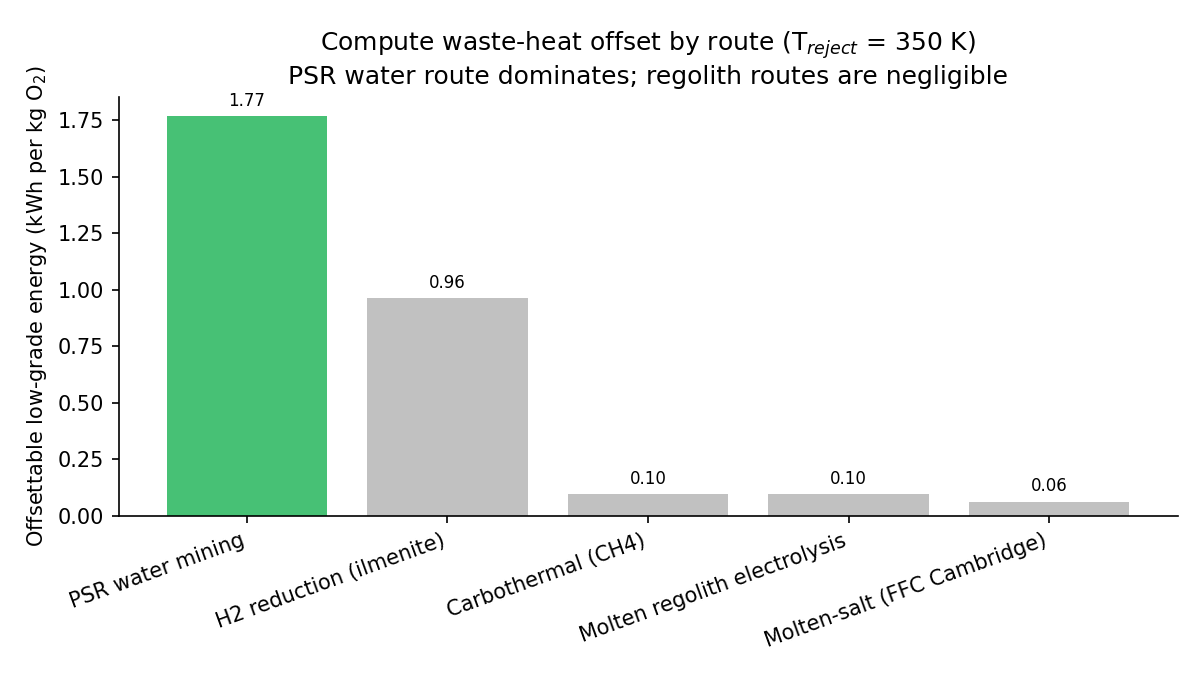
Figure 2. Low-gradeLow-grade heatHeat available only at modest temperature; useful for ice sublimation but useless for high-temperature reduction., waste-heat-offsettable energy per route (T_rejectReject temperatureThe temperature at which compute waste heat is shed (~315-350 K); it sets how much low-grade ISRU heat that stream can offset. = 350 K, pinch and effectiveness applied).
PSRPermanently Shadowed RegionA crater floor near the poles that never sees sunlight, sitting at ~40-110 K: both the water resource and an ideal cold sink. co-location (
PSR-COLOCATION.md). A permanently shadowed regionPermanently Shadowed RegionA crater floor near the poles that never sees sunlight, sitting at ~40-110 K: both the water resource and an ideal cold sink. is both a cryogenic radiative sinkRadiative sinkA cold surrounding (the ~40-110 K PSR sky) into which a radiator can dump heat; the colder it is, the less radiator mass needed. for compute and the location of the water resource. Under an explicit radiator energy balance with a sky view factor (a competently oriented vertical two-sided panel, F_sky nominal 0.5, replacing an earlier horizontal-panel assumption that overstated the case), PSRPermanently Shadowed RegionA crater floor near the poles that never sees sunlight, sitting at ~40-110 K: both the water resource and an ideal cold sink. siting saves a feasible-case median ~10 t of radiator mass per MWMegawattOne thousand kilowatts of power. of compute (IQRInterquartile RangeThe spread between the 25th and 75th percentiles of a distribution. ~7-16; Figure 3); only ~0.1% of sampled sunlit designs truly cannot reject at 330 K (a further ~0.4% need a prohibitive >10x area), correcting an earlier claim of ~30% that was an artifact of the horizontal-panel geometry. The heat cascade itself is a modest bonus (saves ~2.3 t reactor for the reference plant against ~1 t of integration hardware; the break-even enabling probability is ~44% at nominal, ~50% propagated, with P(worthwhile once co-located) ~78%); co-location is justified by the compute siting economics, not the cascade. This is, fittingly, most useful at the low-temperature water route that Finding 1 already favors.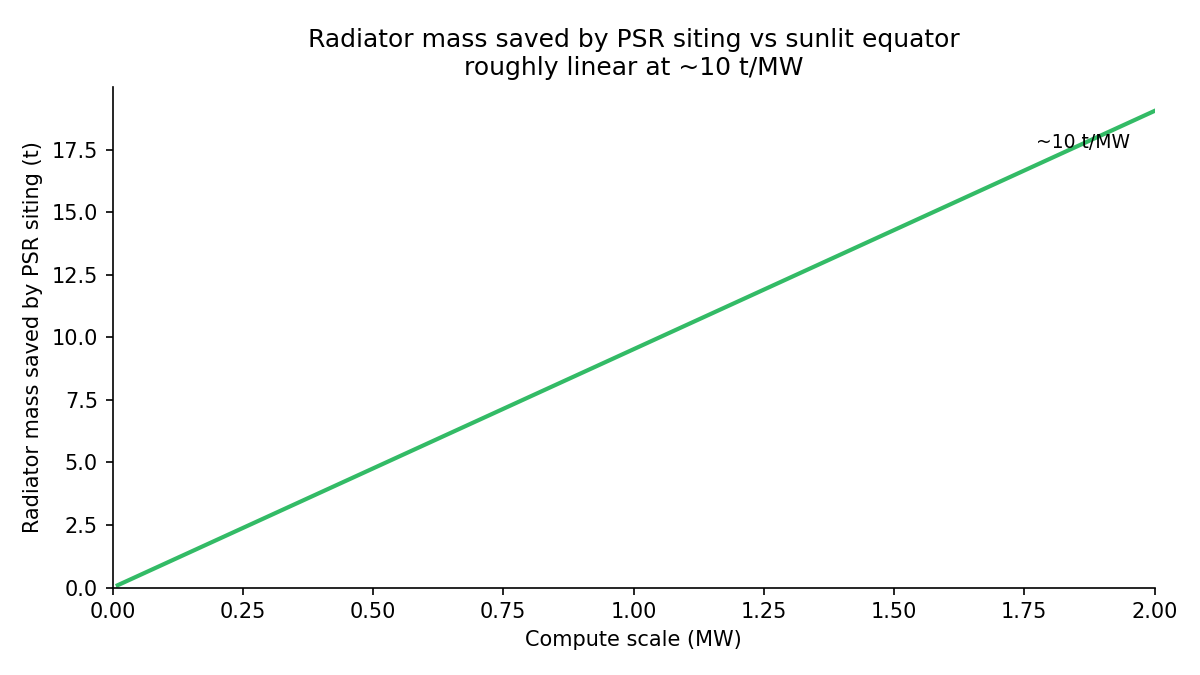
Figure 3. Radiator mass saved by PSRPermanently Shadowed RegionA crater floor near the poles that never sees sunlight, sitting at ~40-110 K: both the water resource and an ideal cold sink. siting vs a sunlit vertical-panel site (feasible-case median ~10 t/MWMegawattOne thousand kilowatts of power.; the saving is right-skewedRight-skewedA distribution with a long high-side tail, so its mean sits above its median; true of the reactor-loss-bearing routes.).
9. Limitations
- Steady-state production energy, power, and FSPFission Surface PowerA surface nuclear reactor for electricity; the paper converts each route’s energy into the landed mass of FSP it would need. landed mass only; capital cost, mobility, comms, site logistics, and demand are out of scope.
- The largest previously-omitted water-route terms are now charged (capture efficiency, cryogenic excavation, PSRPermanently Shadowed RegionA crater floor near the poles that never sees sunlight, sitting at ~40-110 K: both the water resource and an ideal cold sink. standing loss, ice thermal chain; Section 2.6). Terms still omitted are one-signed (they raise totals) and still fall disproportionately on the water route: months-long LH2Liquid HydrogenCryogenic liquid H2 (boils ~20 K); the fuel half of a complete LOX+LH2 propellant. zero-boil-offZero-boil-off (ZBO)Active refrigeration that re-condenses vapor so no cryogen is lost; needed for months-long 20 K LH2 storage. storage, power delivery into permanent shadow, mobility and haulage in a PSRPermanently Shadowed RegionA crater floor near the poles that never sees sunlight, sitting at ~40-110 K: both the water resource and an ideal cold sink., and survival heating for equipment at 40-110 K. Omissions against the other routes: comminutionComminutionCrushing and grinding regolith to smaller particle sizes; an omitted (energy-raising) term./beneficiationBeneficiationConcentrating or sorting raw regolith to enrich the useful feedstock before processing. and electrolyzer heat-rejection parasitics. Absolute kWhKilowatt-hourA unit of energy (one kilowatt sustained for one hour). The paper reports kWh per kg of oxygen./kg figures are best read as lower bounds; the ranking is more robust than the levels, but the remaining asymmetry means the water route's 0.89 dominanceDominance probabilityThe probability one route beats the others, e.g. P(cheapest), read off the paired Monte Carlo. should be read as an upper bound on confidence, not a lower one.
- The solar-thermal sensitivity (Section 5) omits concentrator mass, pointing, and night-survival thermal cycling; it brackets the sunlit case rather than designing it.
- Three of five routes lack a direct independent electrical anchor; the winning route's only anchor is this model itself.
- O2Molecular oxygenThe primary product; energy is reported per kg of O2 delivered to cryogenic storage. yield and reaction temperature are sampled independently (a residual idealization).
- Site geography is not modeled beyond the shadow/sunlit distinction.
10. Reproducibility
pip install -e .
python -m lpem                 # Table 1
python -m lpem --dominance     # Table 2
python -m lpem --sensitivity mre   # Section 5 tornado
python -m lpem --sobol mre          # Section 5 Sobol variance decomposition
python -m lpem --solar-thermal      # Section 5 solar-thermal sensitivity
python -m lpem --plant-tonnes 50   # Section 7
python -m lpem --waste-heat --benefit   # Section 8
python scripts/make_figures.py     # Figures 1-3
pytest                         # 68 tests, incl. the validation anchors
References
See paper/REFERENCES.md (full bibliography with DOIs/URLs) and paper/references.bib.
Key sources: Leger et al. 2025 (PNASProceedings of the National Academy of SciencesThe journal where Leger et al. 2025, the paper’s main validation anchor, appeared.) [leger2025]; Taylor & Carrier 1993
[taylor1993]; Carr 1963 [carr1963]; Allanore 2015 (J. Electrochem. Soc.)
[allanore2015]; Schreiner et al. 2016 (Adv. Space Res.) [schreiner2016sizing]; Kornuta et al.
2019 (REACH) [kornuta2019]; Hauch et al. 2020 (Science) [hauch2020]; Colaprete et al. 2010
(Science) [colaprete2010].